
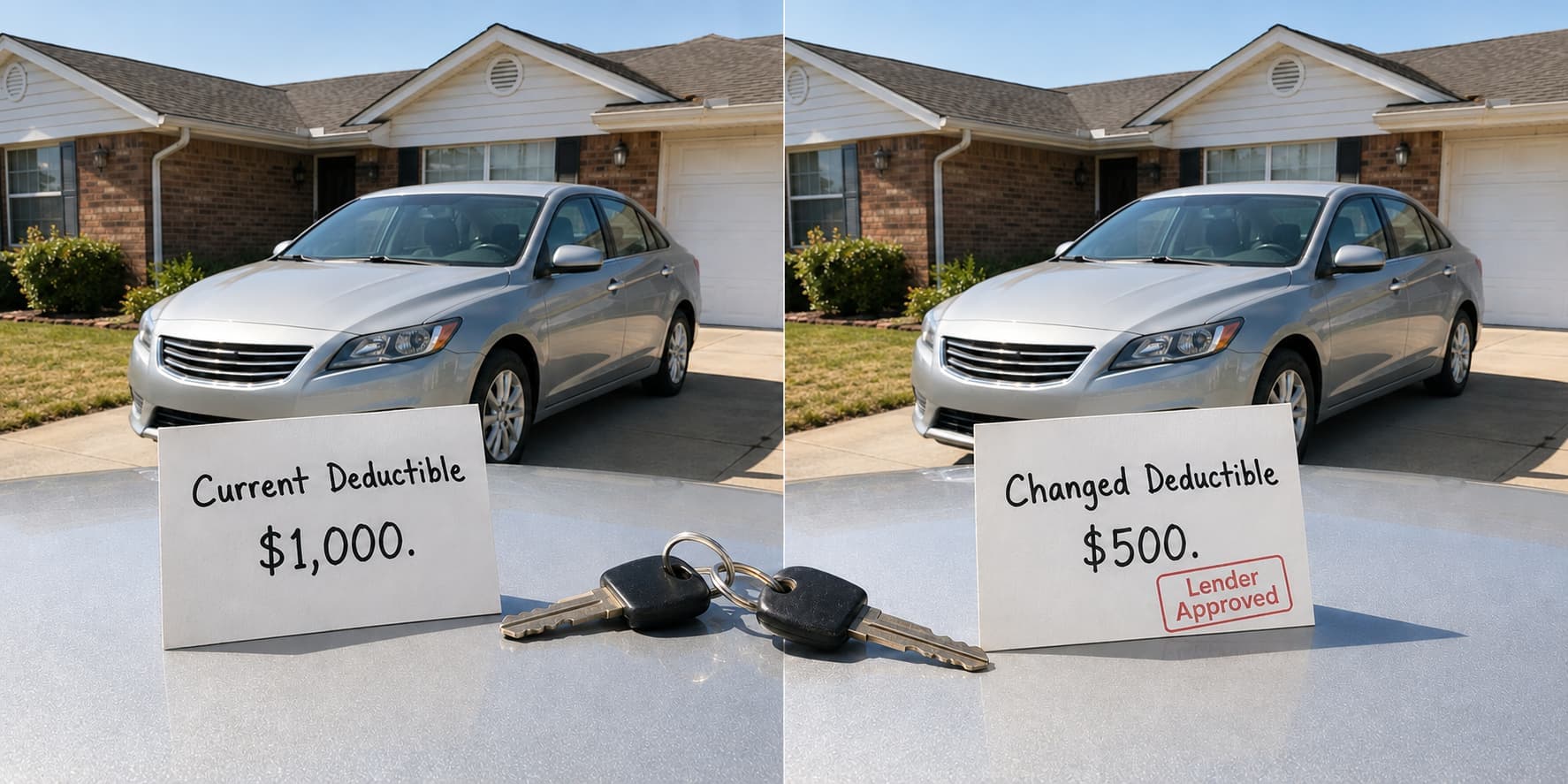
Raising your deductible can sometimes lower the cost of an auto insurance policy. But if your vehicle is still financed, there is another question to answer before making the change:
Does your lender allow it?
Oklahoma does not set one universal comprehensive or collision deductible for financed vehicles. However, an auto loan agreement can require certain physical-damage coverage and may limit how high the deductible can be.
So if you finance a vehicle in Del City and are thinking about changing your deductible, start with the loan agreement and your lender’s requirements.
Here’s what to know.
Can a Lender Limit Your Auto Insurance Deductible?
Yes. A lender may limit the comprehensive or collision deductible you can carry on a financed vehicle.
That is because the vehicle serves as collateral for the loan. The lender has a financial interest in the car until the loan is paid off.
Before changing a deductible, ask:
- What is the highest collision deductible allowed?
- What is the highest comprehensive deductible allowed?
- Do the two deductibles have to be the same?
- Where is the requirement listed in the loan agreement?
Do not assume every lender uses the same limit.
For example, a Del City driver might consider raising a collision deductible from $500 to $1,000 to reduce the insurance premium. If the loan agreement only allows a maximum $500 deductible, the higher amount may not meet the lender’s requirement.
Check the lender’s limit before changing the policy.
Why Does the Lender Care About Your Deductible?
Comprehensive and collision coverage can help pay for covered damage to the financed vehicle, subject to the policy terms and deductible.
The deductible is the amount the policyholder is generally responsible for before the applicable coverage pays on a covered claim.
A higher deductible may mean a lower insurance premium, but it can also mean more money out of pocket after a covered loss.
Because the lender still has a financial interest in the vehicle, it may limit how high that deductible can be.
The important point is simple:
Your insurance company determines which deductible options are available on the policy, while your lender determines what the loan agreement will accept.
Does Oklahoma Require a Certain Deductible on Financed Cars?
No. Oklahoma does not set one universal $500, $1,000, or other comprehensive or collision deductible for every financed vehicle.
Oklahoma’s minimum auto insurance requirement and a lender’s requirements are two different things.
State law determines the minimum liability insurance required to drive legally.
A lender may separately require comprehensive and collision coverage because the financed vehicle secures the loan. The lender may also place limits on the deductibles allowed under that agreement.
So a policy can meet Oklahoma’s legal minimum requirements and still fail to meet the requirements of an auto loan.
That is why financed drivers should check both.
What Information Does Your Lender Need?
Changing a deductible is not only about choosing a new dollar amount.
The lender may also need updated proof showing that the financed vehicle still meets the loan requirements.
Check that the policy information includes the correct:
- vehicle year, make, model, and VIN
- borrower or named insured information
- lienholder name and address
- comprehensive and collision deductibles
- policy effective dates
- lender proof-of-insurance information
Incorrect lender information, an outdated address, or a wrong VIN can make it harder for the lender to match the insurance policy to the loan.
Ask where updated proof of insurance should be sent and keep a copy of anything submitted.
What Happens If the Deductible Does Not Meet the Loan Requirement?
If the deductible is higher than the loan agreement allows, the lender may ask for the coverage to be corrected.
If required physical-damage coverage is missing or does not meet the loan agreement, some lenders may also obtain lender-placed or collateral-protection insurance under the terms of the finance agreement.
That type of insurance should not be assumed to replace a regular personal auto policy.
Lender-placed coverage is generally intended to protect the lender’s financial interest in the vehicle. It may not provide the same protections selected under a personal auto policy or satisfy Oklahoma liability requirements.
The easier approach is to confirm the lender’s deductible and coverage requirements before changing the policy.
Can You Change the Deductible After Paying Off the Car?
Once the loan is fully paid and the lien has been properly released, the lender may no longer control the deductible on the vehicle.
But making the final loan payment does not always mean every record is updated immediately.
Confirm that:
- the loan is paid in full
- the lender has released the lien
- the lienholder information can be removed from the insurance policy
- the title records have been updated as required
The original source notes that an active lien remains reflected until the appropriate lien-release process is completed.
After the lender requirement is gone, the driver can review the policy based on the vehicle and personal situation rather than the loan agreement.
Before Changing a Deductible on a Financed Car in Del City
If you finance a vehicle in Del City and are considering a different deductible, run through this checklist first:
- Check the current loan agreement.
- Ask the lender for the maximum comprehensive deductible.
- Ask for the maximum collision deductible.
- Confirm the lender’s correct name and address.
- Ask where updated proof of insurance should be sent.
- Compare how much the deductible change actually affects the premium.
- Make sure the revised policy still meets the loan requirement.
- Keep the updated declarations page or other proof after the change.
The goal is not simply to choose the highest deductible available.
It is to choose an option that works with both the insurance policy and the financing agreement.
What If You Get Different Answers About the Deductible?
If you are not sure whether a deductible meets the loan requirement, go back to the loan agreement or ask the lender to confirm the maximum deductible it allows.
If possible, get that requirement in writing. Then use it when reviewing the deductible options on the insurance policy.
That way, you are comparing the policy against the actual loan requirement instead of relying on assumptions.
The safest approach is to confirm the lender’s deductible limit before making the chang
Frequently Asked Questions
Does Oklahoma require a $500 deductible on a financed car?
No. Oklahoma does not set a universal $500 comprehensive or collision deductible for financed vehicles. A lender may set its own deductible limit through the loan agreement.
Can I raise my deductible on a financed car?
Possibly. Before raising the deductible, check the loan agreement or contact the lender to find out the highest comprehensive and collision deductibles it allows.
Can I raise my deductible without telling my lender?
Changing the deductible without checking the loan requirements can create a problem if the new amount exceeds the lender’s limit. Confirm the deductible requirement and proof-of-insurance process before making the change.
Does lender-placed insurance replace my regular auto insurance?
Not necessarily. Lender-placed or collateral-protection insurance is generally intended to protect the lender’s interest in the financed vehicle. It should not be assumed to provide the same protection as a personal auto policy or satisfy Oklahoma liability requirements.
Can I change my deductible after paying off the car?
Once the loan and lien are fully resolved, the lender may no longer control the deductible. Confirm the lien release and update the insurance records before making changes based on the loan being paid off.