
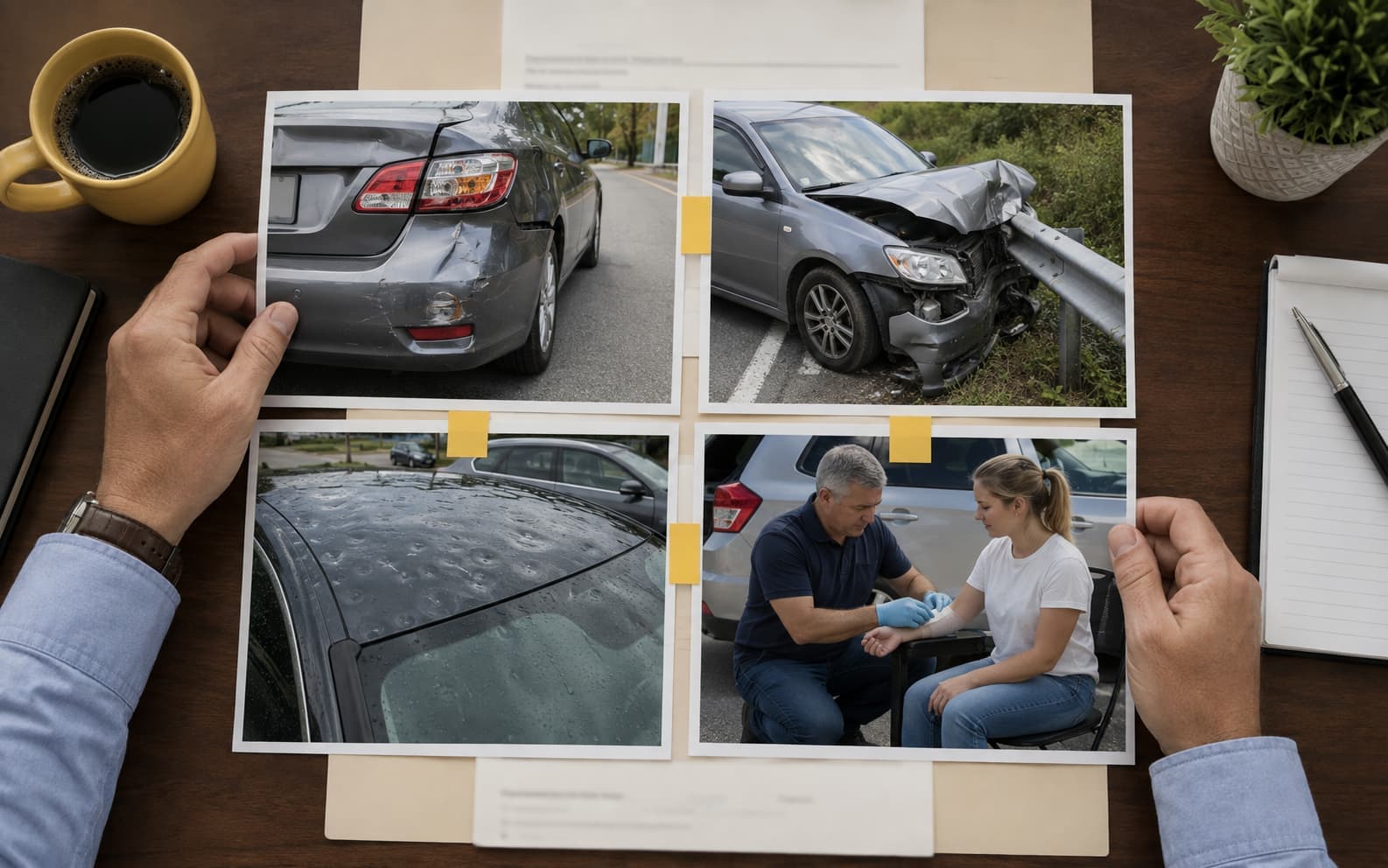
One accident can leave you with several different expenses.
Another driver’s bumper may be damaged. Your own car may need repairs. Someone may need medical care. You might also need a tow or a rental car while your vehicle is in the shop.
Those expenses do not all fall under the same part of an auto insurance policy.
The quickest way to understand which coverage may apply is to separate the accident into two questions:
- Whose property was damaged?
- Who was injured?
From there, you can match each loss to the coverage designed to address it. This guide explains how that works for common accidents involving Oklahoma drivers.
When we help Oklahoma drivers review their coverage, we do not begin by asking only whether they have “full coverage.” We look at the accident one expense at a time: damage to someone else’s property, damage to the insured vehicle, injuries, towing, and transportation while the car is being repaired. Each expense may point to a different part of the policy.
A Quick Accident-to-Coverage Guide
| What happened? | Coverage that may apply |
| You damaged someone else’s vehicle | Property damage liability |
| You damaged a fence, mailbox, pole, or other property | Property damage liability |
| You caused injuries to another person | Bodily injury liability |
| Your own car was damaged in a crash | Collision coverage |
| You or your passengers were injured | Medical payments coverage, if purchased |
| An uninsured or underinsured driver injured you | Uninsured/underinsured motorist bodily injury coverage, if included |
| An uninsured driver damaged your car | Collision coverage, if purchased |
| You struck a deer or another animal | Comprehensive coverage |
| Your vehicle needed a tow | Towing coverage or applicable claim expenses, depending on the policy and circumstances |
| You needed a temporary vehicle | Rental reimbursement or the at-fault driver’s insurer, depending on the claim |
This table is a starting point. Collision and comprehensive are commonly grouped with liability under the phrase full-coverage car insurance in Oklahoma, but each coverage still has a different job after an accident. What applies depends on the policy, its limits and deductibles, the cause of the loss, and the facts established during the claim.
If You Damage Someone Else’s Car or Property
Suppose you misjudge the distance while changing lanes and strike another vehicle.
If you are responsible for the accident, the property damage liability portion of your policy may pay for covered damage to the other vehicle, up to your policy limit. It may also apply when you damage property other than a car, such as:
- A fence
- A mailbox
- A utility pole
- A guardrail
- A storefront
- A building
Property damage liability does not pay to repair your own vehicle.
For example, imagine that you slide on a wet Oklahoma road and hit a guardrail. Property damage liability may apply to the damaged guardrail. If your car is also damaged, you would generally need collision coverage for your own repairs.
The same accident can activate separate coverages for separate losses.
If You Cause Injuries to Another Person
If another driver, passenger, pedestrian, or cyclist is injured in an accident for which you are responsible, bodily injury liability may apply.
Depending on the claim and policy terms, it may help cover qualifying expenses such as medical bills, lost income, and legal defense costs. Coverage only applies up to the policy’s limits, so the declarations page is the place to check how much bodily injury liability your policy carries.
Bodily injury liability is intended for injuries to other people. It generally does not pay your own medical expenses.
If Your Own Car Is Damaged in the Crash
Damage to your own vehicle usually falls under collision coverage when the loss results from your car colliding with another vehicle or object.
Collision may apply when you:
- Rear-end another car
- Back into a pole
- Strike a guardrail
- Hit a pothole and damage the vehicle
- Lose control and roll the car
- Are hit by another driver
Collision coverage can apply regardless of who caused the accident. You normally pay the collision deductible shown on your policy, and the insurer pays the covered repair cost above that amount, subject to the policy and the vehicle’s value.
Drivers sometimes assume the other person’s insurance must handle their vehicle because the other driver caused the crash. However, collision coverage applies to covered damage to your own vehicle and may be available even while responsibility is being investigated.
A lender may also require collision and comprehensive coverage throughout the loan, which makes these protections especially important when reviewing insurance requirements for a financed car in Oklahoma.
If Another Driver Caused the Accident
When another driver is responsible, you may be able to make a claim against that driver’s property damage liability coverage. This is known as a third-party claim.
That is not always your only option.
If your own policy includes collision coverage, you may be able to use it to begin repairing your car while the insurers investigate responsibility. Your collision deductible may initially apply. Your insurer may then seek reimbursement from the responsible driver or insurer, a process commonly called subrogation. Any deductible reimbursement will depend on what the insurer recovers and the circumstances of the claim.
Oklahoma drivers are not necessarily limited to waiting on the other company. According to the Oklahoma Insurance Department’s guide to auto insurance and accidents, a driver who carries collision coverage may file through their own insurer even when another person caused the crash.
Which route makes more sense can depend on whether responsibility is disputed, how quickly the other insurer accepts the claim, the extent of the damage, and whether you can manage your deductible while the claim is reviewed.
If the Other Driver Has No Insurance—or Not Enough
This is where Oklahoma coverage can be misunderstood.
Uninsured/underinsured motorist coverage in Oklahoma generally applies to bodily injuries—not damage to your vehicle. Oklahoma’s consumer guidance makes that distinction directly. The coverage may help when you or another covered person is injured by a driver who has no liability insurance, does not have enough insurance, or leaves the scene in a hit-and-run.
It does not take the place of collision coverage for damage to your car.
For example, if an uninsured driver runs a red light and hits you:
- Your collision coverage may apply to your damaged vehicle.
- Your uninsured motorist bodily injury coverage may apply to qualifying injuries, if it is included in your policy.
That distinction is especially important when reviewing uninsured motorist coverage in Oklahoma. The word motorist can make the coverage sound broader than it is, but the exact protection is defined by the policy and Oklahoma law.
If You or Your Passengers Need Medical Care
If your policy includes medical payments coverage, often called MedPay, it may help with qualifying medical or funeral expenses for you, resident relatives, and passengers covered by the policy.
MedPay generally applies regardless of who caused the accident. That can make it useful while responsibility is still being investigated.
Depending on the situation, medical expenses may also involve:
- The at-fault driver’s bodily injury liability coverage
- Your health insurance
- Your uninsured/underinsured motorist coverage
- Another available auto policy
These coverages do not necessarily pay the same expenses in the same way. Ask the claim representative which policy is being used, what documentation is required, and whether repayment or coordination between coverages could affect the claim.
If You Hit a Deer or Another Animal
Hitting an animal is generally handled differently from hitting another car or a fixed object.
Direct contact with a deer or another animal normally falls under comprehensive coverage. Comprehensive is the portion of an auto policy that applies to many losses that are not vehicle collisions, including theft, hail, vandalism, fire, falling objects, and animal strikes.
Animal strikes are only one example of the losses comprehensive coverage may address for Oklahoma vehicles, along with covered hail, theft, vandalism, fire, and falling-object damage.
But a small change in the event can change the coverage.
Suppose a deer runs into the road. If you strike the deer, comprehensive would generally apply. If you avoid the deer but collide with a tree or guardrail, that vehicle damage would generally be treated as a collision claim.
The claim decision is based on what actually caused the damage, so explain the sequence clearly and provide photographs when possible.
The Oklahoma Insurance Department also identifies direct contact with an animal as a comprehensive loss. Its Oklahoma deer-collision guidance recommends documenting the vehicle, roadway, and resulting damage once the scene is safe.
If the Car Needs to Be Towed
Towing is not automatically included just because your policy has liability, collision, and comprehensive coverage.
If you purchased towing and labor or roadside assistance, that coverage may help with an eligible tow. In some covered accidents, towing from the scene may instead be handled as part of the physical-damage claim. The answer depends on the policy and why the tow was necessary.
Before authorizing a tow, ask where the vehicle is going and whether storage charges will begin. Keep the towing receipt and give the insurer the location of the vehicle as soon as possible. Daily storage fees can add up while a damaged car sits at a tow yard.
If You Need a Rental Car
A policy can include collision and comprehensive coverage without including rental reimbursement.
If you caused the accident or need to use your own policy, rental reimbursement may help pay for a temporary vehicle when you purchased that coverage and the loss qualifies. The policy may include a daily limit, a total maximum, or restrictions on how long it pays.
If another driver caused the accident, that driver’s insurer may pay reasonable rental expenses after it accepts responsibility. However, a rental vehicle is not guaranteed in every situation, and delays can occur while the claim is being investigated.
Before renting a car, confirm:
- Which insurer is authorizing it
- The approved daily rate
- How long the authorization lasts
- Whether taxes and additional charges are included
- What happens if repairs take longer than expected
“Full coverage” does not automatically mean rental coverage is included.
What We Would Check on the Policy
If an Oklahoma driver asked which coverage could apply after an accident, we would first verify:
- The vehicle involved is listed on the policy
- The applicable coverage was active on the accident date
- Collision, comprehensive, MedPay, rental, or towing appears for that specific vehicle
- The deductible and coverage limits shown on the declarations page
- Whether the claim is being made through the driver’s own policy or another party’s policy
The coverage name identifies the possible starting point. The policy and accident details determine whether the particular loss is covered.
How to Confirm Which Coverage You Actually Have
The coverage name tells you what part of the policy may apply. Your policy documents tell you whether you purchased it and how much protection you have.
Start with the declarations page. Look for:
- Liability coverage and its limits
- Collision coverage and its deductible
- Comprehensive coverage and its deductible
- Uninsured/underinsured motorist coverage
- Medical payments coverage
- Rental reimbursement
- Towing or roadside assistance
- The specific vehicles covered by each selection
Do not assume every vehicle on a multi-car policy carries the same coverage. One vehicle may have collision, comprehensive, and rental reimbursement while another carries liability only.
One detail we encourage drivers to check is whether each vehicle carries the same selections. Seeing a coverage elsewhere on the declarations page does not necessarily mean it applies to the vehicle involved in the accident. If some of the language is unfamiliar, understanding terms such as coverage selections, deductibles, and policy dates can make the document easier to review.
Then ask the claim representative to explain:
- Which coverage is being used for each expense?
- What deductible applies?
- What limit or maximum applies?
- What documents or receipts are needed?
- Is responsibility for the accident still being investigated?
- Could another insurer reimburse any part of the claim?
One Accident May Involve More Than One Coverage
There is not always one simple answer to “Which insurance covers this accident?”
If you cause a crash that damages another vehicle, injures its driver, and damages your own car, three different coverages could be involved: property damage liability, bodily injury liability, and collision.
That is why the best place to begin is not with the phrase full coverage. Begin with each individual loss:
- Who was injured?
- Whose vehicle or property was damaged?
- What caused the damage?
- Which optional coverages appear on the policy?
Once those details are separated, it becomes much easier to see which part of the policy may apply.
If you are reviewing your Oklahoma auto insurance before an accident occurs, Cheapest Auto Insurance can help you understand the available coverage options and check for a policy that fits your vehicle and situation.
Frequently Asked Questions
Does liability insurance pay for my car after an accident?
Your own liability coverage generally does not pay to repair your vehicle. It applies to covered injuries or property damage for which you are responsible. Collision coverage is normally the coverage used for your own accident damage.
Does collision coverage apply if the accident was my fault?
Yes. Collision coverage may pay for covered damage to your vehicle regardless of fault, subject to the deductible, policy terms, and the vehicle’s value.
What pays for my car if an uninsured driver hits me in Oklahoma?
Collision coverage may apply if you purchased it. Oklahoma uninsured/underinsured motorist coverage generally applies to bodily injury and does not cover damage to your vehicle.
Does full coverage include towing and a rental car?
Not necessarily. Towing and rental reimbursement are commonly separate selections. Check the declarations page to see whether they are included and what limits apply.
Is hitting a deer a collision or comprehensive claim?
Directly hitting a deer or another animal is generally a comprehensive claim. If you avoid the animal and strike another vehicle or object, the resulting damage is generally handled under collision coverage.
Can I use my collision coverage when the other driver caused the accident?
You may be able to use your collision coverage, although your deductible may initially apply. Your insurer may later seek reimbursement from the responsible party. Ask how deductible recovery would be handled in your particular claim.