
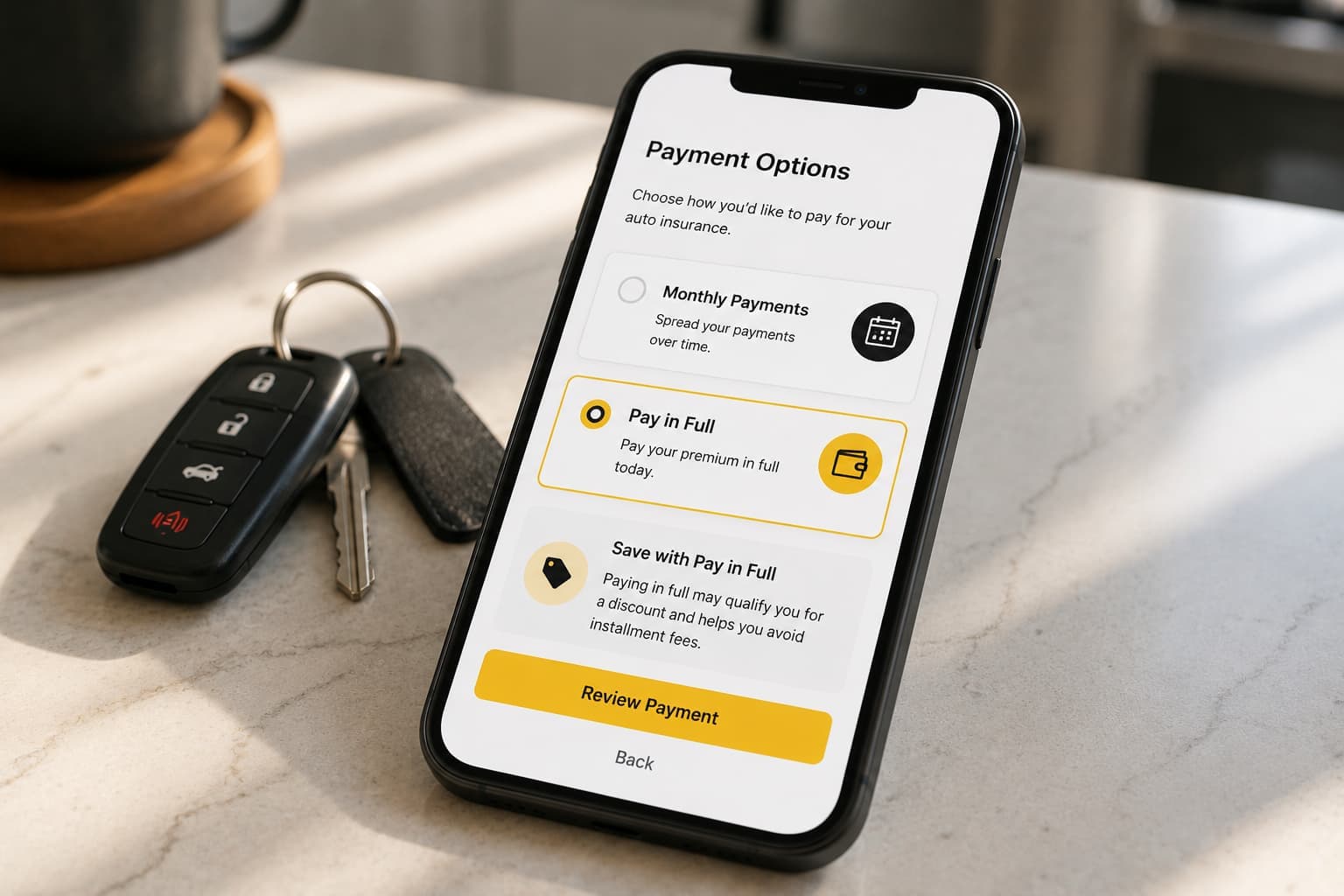
Encontrar una cotización de seguro de auto accesible es solo parte de la decisión. Una vez que conoce el precio, todavía tiene que elegir cómo pagar la póliza.
¿Debe pagar toda la prima de una vez o hacer pagos más pequeños a lo largo del período de la póliza?
Pagar por completo puede costar menos cuando la compañía de seguros ofrece un descuento o cobra cargos por mensualidades. Los pagos mensuales requieren menos dinero por adelantado y pueden ser más fáciles de manejar.
La mejor opción depende de cuatro cifras:
- El monto que debe hoy
- El monto de cada pago futuro
- Cualquier cargo por facturación o mensualidades
- El costo total al final del período de la póliza
El total más económico y el pago más fácil no siempre son lo mismo.
¿Qué significa pagar mensualmente?
Pagar mensualmente significa que la prima se divide en mensualidades programadas en lugar de cobrarse en un solo pago.
Para muchos conductores de Oklahoma, esta es la forma más práctica de iniciar la cobertura porque reduce el monto necesario por adelantado. En lugar de pagar varios cientos de dólares de una vez, el cliente puede repartir el costo a lo largo del período de la póliza.
Sin embargo, la palabra “mensual” no siempre significa seis pagos iguales en una póliza de seis meses.
El primer pago puede ser mayor o menor que los pagos restantes. Algunas compañías de seguros también cobran un cargo por facturación o mensualidad cada vez que se procesa un pago.
Antes de iniciar la póliza, pida ver el calendario completo de pagos. No juzgue el plan solo por el primer monto a pagar.
Cuándo tienen sentido los pagos mensuales
Los pagos mensuales pueden ser la mejor opción cuando:
- Pagar toda la prima tomaría demasiado del presupuesto actual.
- Un pago más pequeño es más fácil de planear con cada quincena.
- Mantener dinero disponible para la renta, los servicios, la despensa, la gasolina o las reparaciones del vehículo es más importante.
- El cliente prefiere pagos automáticos en lugar de una transacción grande.
- La diferencia entre el total mensual y el total pagado por completo es pequeña.
Elegir pagos mensuales no significa que el conductor haya tomado una mala decisión financiera.
Suponga que pagar por completo le ahorraría $30, pero hacerlo dejaría muy poco dinero disponible para una reparación inesperada o una cuenta del hogar. En esa situación, pagar un poco más mediante mensualidades puede valer la flexibilidad.
La meta no es simplemente elegir el total más bajo. La meta es elegir un plan de pago que se pueda sostener durante todo el período de la póliza.
¿Qué significa pagar por completo?
Pagar por completo significa pagar la prima total del período de la póliza de una sola vez.
Una vez hecho el pago, no hay mensualidades recurrentes de prima durante ese período. El cliente aún deberá estar atento a los avisos de renovación, pero no tendrá cuentas mensuales de seguro que administrar hasta que la póliza se renueve.
Algunas compañías de seguros ofrecen un descuento por pago completo. Pagar por adelantado también puede eliminar los cargos por mensualidades.
Cuando aplica cualquiera de los dos, pagar por completo puede reducir el costo total de la póliza.
Cuándo tiene sentido pagar por completo
Pagar por completo puede ser la opción más fuerte cuando:
- La compañía de seguros ofrece un descuento por pago completo que valga la pena.
- Las mensualidades incluyen cargos de facturación repetidos.
- La prima total se puede pagar sin afectar los gastos esenciales.
- El cliente quiere menos cuentas y fechas de vencimiento que rastrear.
- El total pagado por completo es claramente menor que el total en mensualidades.
Aquí va una regla sencilla: no vacíe un fondo de emergencia solo para recibir un pequeño descuento de seguro.
Un descuento solo es valioso cuando el pago más grande cabe cómodamente en el presupuesto. Si el dinero ya está disponible y no se necesitará para otros gastos, pagar por completo puede ser una forma sencilla de reducir el costo total.
Pagos mensuales frente a pago completo
| Pagos mensuales | Pago completo |
| Menor monto a pagar por adelantado | Mayor monto a pagar por adelantado |
| El costo se reparte a lo largo del período de la póliza | Toda la prima se paga de una vez |
| Puede incluir cargos por mensualidades o facturación | Puede evitar cargos por mensualidades |
| Más fácil para algunos presupuestos familiares | Puede calificar para un descuento |
| Requiere varias fechas de vencimiento | Sin pagos recurrentes de prima durante el período |
| Puede costar más en total | Puede costar menos en total |
El lado derecho de la tabla no es automáticamente mejor. Pagar por completo solo tiene sentido cuando el monto inicial es accesible.
¿Qué opción de pago suele costar menos?
Pagar por completo a menudo tiene el potencial de costar menos, pero no está garantizado.
La diferencia normalmente viene de:
- Un descuento por pago completo
- Cargos por mensualidades o facturación agregados al plan mensual
Algunas compañías de seguros ofrecen ambos. Otras ofrecen solo uno. En algunos casos, la diferencia entre las dos opciones puede ser pequeña.
Considere este ejemplo:
- Precio pagado por completo: $720
- Plan mensual: seis pagos de $125
- Costo mensual total: $750
- Ahorro por pagar por completo: $30
En este ejemplo, pagar por completo cuesta menos.
Pero la siguiente pregunta es igual de importante: ¿pagar $720 hoy le crearía un problema?
Si la respuesta es no, pagar por completo puede ser la mejor opción. Si el pago interfiriera con la renta, los servicios, la despensa o los ahorros de emergencia, el plan mensual puede ser la mejor decisión aunque cueste $30 más.
Un ejemplo realista de Oklahoma
Considere a un conductor de Oklahoma que recibe una cotización para una póliza de seis meses.
El conductor puede pagar $690 por completo o iniciar la cobertura con un pago menor y hacer mensualidades que suman $724 después de los cargos.
Si el conductor ya tiene apartados $690, pagar por completo le ahorra $34 y elimina varias fechas de vencimiento futuras.
Si el conductor también necesita llantas nuevas antes del invierno, usar los $690 completos para el seguro puede no dejarle espacio para la reparación. En ese caso, el plan mensual puede darle una flexibilidad más útil.
Ninguna opción es automáticamente correcta o incorrecta. La mejor decisión depende del costo total y del presupuesto actual del cliente.
El total más económico y el pago más fácil son cosas distintas
Los conductores que comparan seguros de auto económicos en Oklahoma deben ver dos preguntas separadas.
¿Qué opción cuesta menos en total?
Sume cada mensualidad y cada cargo, y luego compare esa cifra con el monto del pago completo.
¿Qué opción es más fácil de sostener?
Mire el monto a pagar hoy y cada fecha de vencimiento futura.
Un primer pago bajo no ayuda si las mensualidades posteriores son difíciles de pagar. Un descuento por pago completo no ayuda si el pago inicial crea un problema financiero mayor.
El mejor plan equilibra el costo total con una accesibilidad realista.
Qué comparar antes de elegir
Pida ambas opciones por escrito antes de contratar la póliza.
La comparación debe incluir:
- El monto necesario para iniciar la cobertura
- El número de mensualidades restantes
- El monto de cada mensualidad
- Cada fecha de vencimiento
- Cualquier cargo por facturación, servicio o mensualidad
- El monto del pago completo
- Cualquier descuento por pago completo
- El costo total bajo cada opción
Esto evita un error común: elegir un plan porque el primer pago se ve barato sin revisar cuánto costará la póliza al final del período.
Errores comunes de pago
Comparar solo el primer pago
Un pago inicial bajo puede verse atractivo, pero no muestra el costo completo. Revise siempre cada mensualidad programada.
Olvidar los cargos por mensualidades
Un cargo pequeño puede no parecer importante, pero los cargos repetidos pueden aumentar el costo total durante una póliza de seis o doce meses.
Pagar por completo sin proteger el resto del presupuesto
Ahorrar dinero en el seguro es útil. Usar dinero necesario para la renta, la comida, los servicios o reparaciones de emergencia no lo es.
Suponer que cada pago mensual será idéntico
El primer pago puede ser distinto de las mensualidades posteriores. Revise el calendario de facturación real en lugar de suponer que la prima se dividirá de forma pareja.
Ignorar las fechas de vencimiento futuras
Los pagos mensuales solo funcionan cuando las mensualidades posteriores también caben en el presupuesto. Elija una fecha de vencimiento y un monto de pago que pueda sostener.
¿Se puede cambiar el método de pago después?
Es posible que pueda cambiar el método de facturación, pero las opciones disponibles dependen de la compañía de seguros y del momento en que se haga la solicitud.
A un cliente que empieza con pagos mensuales se le puede permitir pagar el saldo restante por adelantado. Sin embargo, pagar el saldo después puede no generar el mismo descuento que estaba disponible cuando inició la póliza.
Un cliente que pagó la prima completa generalmente no puede convertir ese pago ya realizado en mensualidades para el mismo período de póliza. Puede haber un plan de facturación distinto disponible al renovar.
Pregunte cómo se manejan los cambios de pago antes de contratar la póliza, sobre todo si espera que su situación financiera cambie durante el período.
¿Qué pasa si se omite un pago mensual?
Un pago omitido puede derivar en un aviso de retraso, un cargo o la cancelación de la póliza si el monto no se paga dentro del plazo que permite la compañía de seguros.
Por eso los pagos posteriores importan tanto como el monto necesario para iniciar la póliza.
Los pagos automáticos pueden facilitar el manejo de las fechas de vencimiento, pero los clientes aún deben revisar los avisos de facturación y confirmar que haya dinero suficiente antes de cada retiro programado.
Pagar por completo elimina el riesgo de omitir una mensualidad recurrente de prima durante el período actual. No elimina la necesidad de estar atento a la fecha de renovación y al siguiente pago de la póliza.
Cómo decidir entre pago mensual y pago completo
Use estas tres preguntas:
- ¿Qué opción cuesta menos al final del período de la póliza?
- ¿Cuánto dinero se requiere hoy?
- ¿Qué plan de pago puedo sostener sin alterar mi presupuesto?
Pagar por completo puede ser la mejor opción cuando genera ahorros claros y el pago inicial resulta cómodo.
Los pagos mensuales pueden ser la mejor opción cuando mantener bajo el costo inicial es más importante y las mensualidades futuras son accesibles.
No hay necesidad de adivinar. Pídale al agente que le muestre ambas opciones lado a lado.
Preguntas frecuentes
¿Pagar el seguro de auto por completo es más barato?
Puede serlo. Pagar por completo puede costar menos cuando la compañía de seguros ofrece un descuento, cobra cargos por mensualidades o ambas cosas. Compare el total mensual completo con el monto del pago completo.
¿Los pagos mensuales de seguro de auto son más caros?
A veces. Los planes mensuales pueden costar más por los cargos por mensualidades o porque el cliente no recibe un descuento por pago completo. En algunas compañías hay poca diferencia entre las dos opciones.
¿Pagar por completo cambia la cobertura?
No. La cobertura elegida debe seguir siendo la misma, ya sea que la prima se pague mensualmente o por completo. El método de pago afecta la facturación, no la cobertura elegida en la póliza.
¿Pagar por completo baja la tarifa del seguro?
Puede bajar el monto total pagado, pero no cambia la cobertura de fondo. El ahorro normalmente viene de un descuento por pago, de evitar cargos por mensualidades, o de ambos.
¿Puedo pagar el saldo restante por adelantado?
Muchas compañías lo permiten. Sin embargo, pagar el saldo después puede no calificar para el mismo descuento que se ofrecía cuando inició la póliza. Pregunte cómo afecta el pago anticipado al monto restante.
Compare ambas opciones antes de iniciar la póliza
Un seguro de auto económico debe ajustarse tanto al presupuesto total como a la forma en que el cliente administra su dinero durante el mes.
Antes de contratar una póliza, pida el calendario de pagos mensuales y el monto del pago completo. Compare el monto a pagar hoy, el costo total, cualquier cargo por mensualidades y cualquier descuento disponible.
Si pagar por completo claramente ahorra dinero y el pago más grande resulta cómodo, puede ser la mejor opción. Si pagar por adelantado generaría presión financiera, un plan mensual manejable puede valer el costo adicional.
La mejor opción de pago es la que sigue siendo accesible desde el primer pago hasta el final del período de la póliza.