
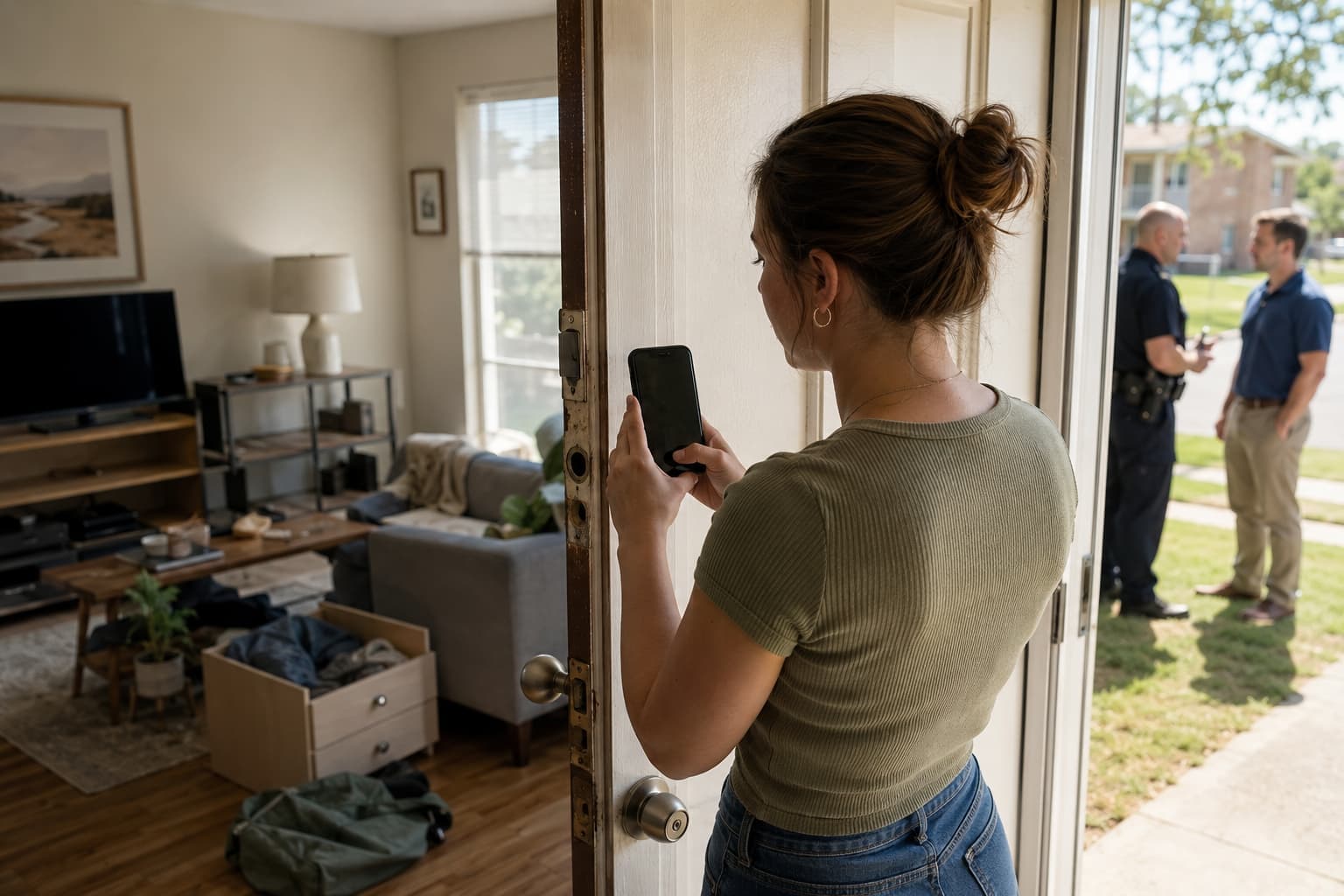
You open the door and immediately know something is wrong.
A window is broken. Drawers have been pulled open. Something that should be there is gone.
After a break-in, it is easy to focus on what was stolen. But the first few steps matter just as much as the insurance claim that comes later.
Before you start cleaning up, replacing belongings, or trying to figure out what renters insurance may cover, make sure the property is safe and document what happened.
Start with safety. Then create a clear record of the break-in before anything gets moved or repaired.
From there, you can work through the police report, landlord notification, stolen-property list, and renters insurance claim one step at a time.
Make Sure It Is Safe Before You Go Inside
If you arrive home and see obvious signs of a break-in, do not rush inside just to see what is missing.
If there is any chance someone could still be inside, contact law enforcement and follow their instructions.
Your belongings can wait.
Once the property is safe to enter, you can start figuring out what happened and what needs to be reported.
Report the Break-In to Police
One of your first steps should be reporting the break-in.
A police report creates an official record of what happened and may be requested when you file a renters insurance theft claim.
You may not know everything that was stolen right away.
That is okay.
Start with what you know, and keep the report number somewhere you can easily find it.
As you go through the rental later, you may notice additional missing items that were not obvious at first.
Take Pictures Before You Clean Anything Up
Your first instinct may be to put the room back together.
Take a few pictures first.
Photograph anything that shows what happened, such as:
- a damaged door or lock
- a broken window
- opened drawers or cabinets
- damaged furniture
- empty spaces where property was taken
- other visible damage
You do not need professional photos.
You are simply creating a record of how the rental looked after the break-in.
If a door or window needs to be secured right away, photograph the damage before repairs when it is safe and practical to do so.
Let Your Landlord Know What Happened
A break-in can involve two different kinds of property.
There is the rental itself.
Then there are the things you own inside it.
If someone damaged a door, window, lock, frame, or another part of the building while breaking in, let the landlord or property manager know.
Your landlord’s insurance and your renters insurance generally serve different purposes.
The landlord is responsible for the property they own.
Your renters policy is where your stolen or damaged personal belongings may come into the picture.
A broken front door and a stolen laptop may have happened during the same break-in, but they are not necessarily handled the same way.
Make a List of What Was Stolen
Once the immediate situation is under control, go through the rental one room at a time.
Write down everything you believe is missing.
For each item, include as much information as you reasonably can:
- what the item was
- brand
- model
- approximate age
- approximate purchase price
- serial number, if available
- where you bought it
Do not worry if you cannot remember every detail immediately.
Start with what you know.
You can add information as you find receipts, old pictures, emails, or other records.
What If You Don’t Have Receipts?
A lot of people do not keep a paper receipt for every television, laptop, pair of headphones, or piece of furniture they own.
That does not mean you should give up on documenting the item.
Look for other records.
You might have:
- online order histories
- emailed receipts
- bank or credit card statements
- photos showing the item in your home
- warranty information
- product registration emails
- serial numbers
- original packaging or manuals
Even an old photo can sometimes help show that you owned something before the break-in.
If you already have a home inventory, this is exactly when it becomes useful.
If you do not, gather whatever records you can and ask the insurance company what documentation it needs.
Contact Your Insurance Company
You do not need to solve the entire claim before you make the first call.
Once the immediate safety issues have been handled and the break-in has been reported, contact your insurance company or agency.
Explain what happened.
Be ready to provide information such as:
- when the break-in happened
- the police report number
- what was damaged
- what you know was stolen
- photographs of the scene
- any receipts or ownership records you already have
If your list of stolen belongings is still incomplete, say so.
Ask what the insurer needs next and how additional information should be submitted.
The goal of the first call is not to have every answer. It is to get the claim started and understand what comes next.
How Renters Insurance Can Help After a Theft
Renters insurance commonly includes personal property coverage that may apply when belongings are stolen in a covered theft.
That could include things such as:
- clothing
- furniture
- electronics
- kitchen items
- tools
- other personal belongings
But “renters insurance covers theft” does not mean every theft claim works exactly the same way.
Your policy still matters.
Things that can affect a claim include:
- your personal property limit
- your deductible
- how the policy values damaged or stolen property
- special limits for certain belongings
- exclusions or other policy conditions
That is why it is better to look at what your actual policy says rather than assume everything that disappeared will be handled the same way.
Don’t Forget About the Deductible
The deductible is another part of the claim.
Suppose several belongings are stolen.
The insurance payment is not necessarily:
value of everything stolen = amount you receive
The applicable deductible and the way your policy handles the property can affect the final claim payment.
You do not need to calculate everything yourself before reporting the theft.
Just know what deductible applies and ask how it will be used when the claim is reviewed.
Some Belongings May Be Treated Differently
Not every item you own necessarily has identical coverage.
Certain categories of property can have special limits or policy conditions.
If something valuable was stolen, describe exactly what it was rather than grouping it into a general list of household belongings.
For example, if a higher-value item disappears, give the insurer whatever information you have about that specific item.
This is also a good reason to understand your policy before anything happens.
If you own something you would have difficulty replacing, it is worth knowing how your renters insurance handles it.
What If Your Roommate’s Stuff Was Stolen Too?
A break-in may affect everyone living in the rental.
That does not automatically mean one person’s renters policy covers everyone’s property.
Imagine your laptop and your roommate’s gaming system are both stolen.
You live at the same address, but that does not necessarily mean both items belong on the same renters insurance claim.
Who is covered depends on the policy and household situation.
If you live with an unrelated roommate, do not assume your policy automatically protects their belongings.
Find out who is actually insured under the policy.
What If Your Stuff Was Stolen From Your Car?
This is another situation that can get confusing.
Someone breaks into your car outside your apartment.
They damage a window and steal the backpack sitting inside.
Inside the backpack is your laptop.
Now there may be two separate questions:
What covers the damage to the car?
and
What covers the belongings that were inside it?
Damage to the vehicle is generally an auto insurance issue.
Personal belongings taken from the vehicle may fall under renters insurance, depending on the policy and circumstances.
Do not assume one policy automatically handles the entire incident.
Explain what happened and find out which coverage applies to each part of the loss.
What If You Can’t Stay in the Rental?
A typical break-in may leave behind a damaged lock or window that can be repaired fairly quickly.
Sometimes the damage is more serious.
If the rental cannot safely be occupied after a covered loss, your renters policy may include additional living expense coverage that can help with certain extra costs of temporarily staying somewhere else.
Whether it applies depends on the circumstances and your policy.
If you cannot stay in the rental, tell the landlord and the insurance company right away.
Ask what needs to happen next instead of assuming you need to pay for everything yourself or that every temporary expense will automatically be covered.
Don’t Throw Damaged Property Away Too Quickly
Some items may not have been stolen but could have been damaged during the break-in.
Before throwing something away, take pictures and ask whether the insurance company needs to inspect it or needs additional information.
The same idea applies to replacing stolen property immediately.
There may be things you need right away, and waiting is not always realistic.
Just keep your receipts.
Good documentation can make the rest of the process much easier.
A Simple Checklist After a Break-In
There is a lot happening at once, so keep the order simple.
1. Make sure you’re safe
Do not enter if you believe someone may still be inside or the situation is dangerous.
2. Report the break-in
Contact police and keep the report information.
3. Document what you see
Take photos or video before cleaning up when it is safe to do so.
4. Tell the landlord
Report damage to doors, windows, locks, or other parts of the rental.
5. Make a list
Go room by room and write down what is missing or damaged.
6. Look for proof of ownership
Gather receipts, photos, order histories, statements, serial numbers, or other records.
7. Contact your insurance company
Report the loss and ask what information is needed for the claim.
8. Save everything
Keep claim emails, photos, receipts, the police report, and your property list together.
You do not need to figure out the entire claim in one afternoon. Start by creating a clear record of what happened.
After the Claim, Make the Next Break-In Easier to Document
Hopefully, you never have to go through another one.
But once the immediate claim is behind you, there are a few things worth doing.
Take updated photos of your belongings.
Save receipts for bigger purchases.
Keep serial numbers for important electronics.
Store that information somewhere you can access even if your phone or computer is stolen.
You do not need a complicated spreadsheet with every fork and towel you own.
A simple home inventory can give you a much better starting point if you ever need to remember what was in your home before something disappeared.
Renters Insurance After a Break-In in Oklahoma
Nobody wants to come home to a broken door and missing belongings.
If it happens, focus on the problem in order.
Make sure you’re safe. Report the break-in. Document the scene. Tell the landlord. Figure out what is missing. Then work through the insurance claim.
Renters insurance can be an important part of recovering from a covered theft, but it works best when you understand what your policy covers and can document what you owned.
Cheapest Auto Insurance can help Oklahoma renters review available renters insurance options before something goes wrong.
Because after a break-in, having the right information can make an already stressful situation much easier to sort through.
Frequently Asked Questions
Does renters insurance cover theft after a break-in?
Renters insurance may cover personal belongings stolen during a covered theft. Coverage depends on the policy, deductible, property limits, valuation method, and circumstances of the loss.
Do I need a police report for a renters insurance theft claim?
Report the break-in to police and keep the report information. Your insurance company may request a police report or report number as part of a theft claim.
Can I file a renters insurance claim without receipts?
You may still have other ways to document what you owned. Online order histories, bank or credit card records, photographs, warranties, serial numbers, and other records can be useful. Ask the insurer what documentation it accepts.
Does renters insurance cover my roommate’s stolen belongings?
Not automatically. Whether another person’s belongings are covered depends on who qualifies as an insured under the policy. An unrelated roommate should not assume that living at the same address means sharing renters insurance coverage.
Does renters insurance cover belongings stolen from a car?
Personal belongings stolen from a vehicle may fall under renters insurance depending on the policy and circumstances. Damage to the vehicle itself is generally an auto insurance issue.